
The Business Broker
10 Facts Every Business Owner Must Know Before Engaging Business Brokers
Selling a business is a significant event, whether using a business broker or not. If using a broker, getting the business broker choice wrong, as many business owners do, can be an expensive mistake.
Background: We manage the UK's largest database of business brokers and track business brokers' sector specialisation, fees, contractual terms, awards won and over 100 other data points. Using extensive feedback from business brokers' clients, we advise business owners on how to choose the right broker.
The choice of business broker is the single most important decision when selling a business. Getting the right broker significantly influences the chances of sale & impacts on price achieved. But most business owners choose the wrong broker, largely because they don't have access to the information they need to make the choice.
This page covers the TOP 10 Facts About Business Brokers that business owners / vendors should know. That's followed by the Top 10 Questions About Business Brokers that business owners should ask, complete with answers.
Book a telephone consultation to discuss your specific business broker needs.
Top Ten FAQs About Business Brokers
What are business brokers and what do they do?
How does a business broker sell a business?
What are the chances the broker will sell my business?
Who regulates business brokers?
How do I maintain confidentiality when selling my business?
Do I need a broker who understands my sector?
How much is a fair fee to pay?
What questions to ask when interviewing business brokers?
Can I negotiate fees and terms with a business broker?
What's a business broker contract like?
Who are buy-side business brokers and what do they do?

About what a business broker does
A business broker is a person or firm that assists business owners with the sale of their business. The business could be a sole proprietorship, a partnership, a limited liability company, a PLC or something else. However, most of the best 'intermediaries' who sell businesses don't call themselves 'business brokers'.
Some business brokers also assist with the buying of businesses. A few brokers, a handful of them, act purely on the buy-side ie. they don't take on any sellers as clients. This page is about sell-side brokers; there are about 1,000 sell-side brokers in the UK at any given time.
Business sellers could be missing out on the top talent if they limit their search to 'business brokers'. Here's an overview of the ecosystem, who does what and who sells what type of business. Which of these is the right one for your business?
About how business brokers sell businesses
How does any intermediary / broker go about selling a business? There are enormous differences in the amount of effort various entities put into selling their clients' businesses. This is also in how they go about finding buyers and closing deals (and, therefore, in their success rates and the prices they achieve for their clients). More about that later.
Note: It's generally accepted that the smaller the business, the less sense it makes to use an intermediary / broker. For many micro businesses - one man bands, shops etc - it's better to not use one at all. Should a particular business even use an intermediary? What's the alternative? How one sell the business themselves?
About the chances the business broker will successfully sell my business
Brokerages, on average, sell only about 20% of the businesses they take on! It's best to gnore the (unverifiable) claims many make of 50%, 80% or even 100% success rates.
Even the 20% number is deceptive as it's a figure for the wider market, including mid-cap businesses (which have a higher chance of sale).
Looking at just small businesses, the stats are more dire with fewer than 10% of businesses that go to market actually succeeding in selling. Contrary to the image many brokers try to present, it's very, very difficult to sell a small business. Brokers generally fail to sell most of the businesses they take on. That is a well known and well established fact.
Some of the biggest & best known brokers sell fewer than 5% of the businesses on their books! What can the business owner do to improve chances of sale when using a business broker?
Some of the brokers with the highest failure rates are, not surprisingly, the ones that give clients and prospective clients the highest valuations.
Small business owners, unfortunately, often see these (theoretically possible but practically very, very difficult to achieve) figures as an indication of the broker's competence / motivation. "If he's confident he can get me that price, he must be good.". That is, of course, a mistake, as these businesses often sit on the shelf for a year or two with no offers till they realise their error and drastically reduce their asking price.
About business broker regulation
There is no national regulatory body overlooking business brokers. Brokers need no qualification or licence to practise as a broker. That has resulted in the UK having some very dubious characters operating in this industry. The industry has earned itself a terrible reputation.
Some of the biggest and best known business brokers around are worse than useless. So how do business owners choose the right business broker?
About maintaining confidentiality through the sale attempt
When making enquiries of brokers, one needs to take extreme care with what information is discloses. In many cases, even disclosing the identity of the business puts confidentiality, and the business, at risk. Here's how vendors can protect themselves.
Once shareholders hire a business broker, the broker should take good care of their interests and the interests of the business. Till then the vendor needs to protect themselves and their business from the brokers themselves!
About finding a broker who understands your business
Some brokers specialise in selling businesses in a specific sector or industry. There are major advantages to using a sector specialist. Such brokers can often get double the price that other brokers can achieve for the business! But finding them is not easy.
For example, there are 20+ business brokers in the UK who specialise in selling accountancy practices and only accountancy practices. There's no list anywhere of all the specialists in that industry.
A business owner could spend all day on Google and not find even half of them! We discuss the pros and cons of sector specialisation.
About fees and fair fees

When considering broker fees, the choice is not as simple as no-sale-no-fee vs paying a large retainer. Some of the no-sale-no-fee brokers (not all) are highly exploitative and should be avoided at all costs. If vendors do pay a retainer, how do they know they're going to get value for money? We share some tips here to help get the right deal on fees.
About questions to ask when interviewing business brokers
When interviewing a business broker one needs to ask the right questions. That's an art in itself. This appointment is a considerably more important decision than hiring an employee, but most business owners have never interviewed a business broker. What questions do they ask to judge the broker's competence to sell the business?
We guide business owners through vetting brokers and asking the right questions.
About negotiating fees and terms with a business broker
What the broker won't disclose is that his fees are generally negotiable. Clients can save tens of thousands of pounds in fees, if not more, if they do and say the right things! But it's not a simple matter of making an offer lower than their quote.
In fact, it would be wise to never, ever do that with a corporate finance firm or M&A adviser, these professionals get easily insulted! Vendors need to play it smart if they want a lower price.
We know how to negotiate price because we've negotiated countless such deals. How to negotiate a better deal with the broker?
About the business broker contract
One needs to read the contract extremely carefully and, preferably, get it looked at by a trusted lawyer. Some of these contracts look straightforward but there are a lot of stings in the tail. What to watch out for in business broker contracts.
Buy-side brokers and what they do
As the name implies, buy-side brokers assist buyers, acquirers and investors to find potential businesses to buy (or 'targets'). There are very few buy-side brokers in the UK as most acquirers do their own 'deal sourcing'.
Buy-side business brokers usually charge their clients a monthly fee of £2K - £3K. For this, they'll take the client's search criteria and find businesses that match those criteria. They do this in a number of ways which is a topic beyond the scope of this article.
In addition to the monthly fee, buy side business brokers also typically charge their clients a success fee when a target they've identified ends up getting acquired by their client. The success fee tends to be in the region of 2-3%. This is paid by the buyer / the acquirer when the sale completes.
Why don't sellers go directly to a buy-side broker to sell their business? This is extremely dangerous as the buy-side brokers are paid by the acquirer. These brokers therefore have the acquirer's best interests at heart and, as experts at this game, they are at an advantage over sellers. The difference in deal knowledge is simply scary.
When the buyer is represented in the transaction, it would be wise for the seller to appoint their own broker / corporate finance firm / M&A firm. If not, they are at a severe disadvantage and will invariably lose out!


The Top Business Broker Questions One Should Ask
Which type of broker is right for me?
Is my business too small for a business broker?
How do I find a broker with a high success rate with selling businesses?
Is it possible to choose the 'right' broker and how do I do it?
How do I protect confidentiality about my business being for sale?
Do I need a sector specialist broker?
How much do business brokers charge?
Any good questions to ask a business broker?
How to negotiate price and terms with a business broker?
What to watch out for in business broker contracts?
1. Which type of broker is right for me?
Getting the right type of broker is important when trying to maximise price (and improve chances of successfully selling the business). All of the below players handle the sale of businesses, and here's a brief description of each to give an overview of this ecosystem:
Business Transfer Agents (BTA)
A firm calling itself a BTA is squarely at the bottom of the market selling the smallest businesses - one man bands, newsagents, hair dressing salons, cafes, shops, corner stores and the like. Some business transfer agents call themselves business brokers and there is no clear distinction between the two.
No qualifications are needed to set up as a BTA or broker and most brokers have no formal training. There is also no industry body overseeing their work, no registration scheme, no vetting of BTAs. There isn't an ombudsman to whom a business owner can complain if things don't pan out.
Business Brokers & Business Agents
These range all the way from firms selling one man bands to firms selling smaller enterprises and corporations worth a million or two. As above, no qualifications are required and there is no real, respectable industry body to whom they are accountable. Any claims they make of being members of an industry body should be taken with a pinch of salt.
Some of the larger brokers, however, may have one or more accountants / lawyers working in the business. These professionals are governed by the codes of conduct of their own professional bodies (ICAEW and the SRA respectively).
While the UK has many good business brokers and business transfer agents, the reputation of the industry isn't great. One needs to be extremely cautious when signing up with these outfits.
Corporate Finance Firms
CF firms typically handle the sale of 'lower mid market' businesses / 'lower mid cap' setups. These are businesses with revenue (turnover) of at least £5m. Some go a bit lower and may even accept a £1m - £2m t/o business if the net profit is sufficiently high.
The largest enterprises most of them are capable of handling adequately are organisations with a value of up to £50m or so.
Corporate finance firms are usually run by qualified accountants or they at least have qualified accountants working in them. There is still no licence or authorisation required for setting up as a corporate finance firm. However, given the formal accountancy background of the owners / directors, these firms are often (not always!) more professional.
Some corporate finance firms are, by their own choice, registered with and regulated by the Financial Conduct Authority (FCA) which adds a significant credibility.
Just to make it confusing, not all firms with "Corporate Finance" in their name sell businesses. Some are commercial finance firms ie. they lend money to businesses!
M&A Advisers
M&A advisers sometimes call themselves transaction advisors or consultants or intermediaries or deal advisory services. They are very similar to corporate finance firms in how they operate. These firms, together with corporate finance firms, bridge the gap between business brokers and the large investment banks.
Again, there is no legal requirements on these firms to be registered or licenced (so it's still get a mixed bag).
M&A advisers sometimes get involved earlier in the process - assisting with exit planning, and strategic planning years before a business is taken to market. Many also provide business growth advisory services. They are looking for or creating opportune environments for a “liquidity event” in line with management’s strategic objectives.
These professionals don't need to have formal qualifications to do this job, but most of them do. Like with CF firms above, some M&A advisors are regulated by the FCA.
Investment Banks (IBs)
While all of the above handle what are called 'Main Street' businesses, IBs handle the sale of 'Wall Street' businesses. This term is generally used to mean 'mid market' or 'mid cap' companies - megacorps with a value of over £50m. IBs also assist with raising finance – both equity and debt - for expansionary activities. They get proactively involved in guiding the strategic vision of the management team towards the objective of IPO, merger or acquisition.
IBs are heavily transaction driven with enterprises paying large retainers and large monthly fees for advisory services and for underwriting their securities
At this level, transactions and deal structures are complex and require significant corporate finance expertise. They also need a keen understanding of the regulatory environment to ensure compliance. In the UK, investment banks are heavily regulated.
Commercial Real Estate Agents
CRE agents and commercial property consultants handle the sale of commercial properties. They sell everything from freehold shops and industrial units to B&Bs, factories, leisure centres, shopping complexes and airports. Their focus is real estate / property.
Many CRE agents do a bit of business broking on the side. They'll take on the sale of a going concern, a trading operation / leasehold business. These could be standalone businesses or sold together with sale of the related property.
Some CRE agents also handle the valuation and sale of assets. So if a business is not working out. owners may call a CRE. The CRE will assist getting rid of the stock, machinery or other assets. CREs are also called 'asset valuers', 'asset assessors' or 'commercial property consultants'.
Various others
In addition to the above, and when moving into larger business entities, there are several others. Rule 3 advisers assist minority shareholders and protect their interests through a transaction. NOMADs (nominated advisers) assist with stock market listings - IPO (Initial Public Offerings).
Which type of firm is right for your business?
This isn't easy to answer. Given the reputation of the BTAs and brokers, it may be worth the owner of a really small business (sub £1m in turnover) not using a BTA or broker but selling their business themselves.
For businesses the next size up and worth up to a few million, it's important to get an 'intermediary' matched to the size of the business. Importantly, also, one that understands the sector (in addition to a lot of other criteria).
It isn't easy as there are 1000+ firms in the market and there is no directory to help find the one that is best geared to selling any particular business. The UK has a huge range of broker talent (and that makes the choice difficult).
We assist with getting the right broker - advising on the right partners. Our comprehensive data on the industry is used to match clients with the right intermediary at the right price.
2. Is my business too small for a business broker?
A business needs to be a certain size to benefit from the assistance of a business broker. We've explained the logic to size issues. In short, if the business is not large enough it can't justify the broker fees required to do a proper job and the only brokers that would take it on are the not very good ones!
In our many years of matching businesses with brokers we've found that the competent brokers won't take on enterprises that have a turnover of less than £5m. Yes, their threshold is as high as that! Some will take on a company turning over as little as £1m - £2m but only if it's otherwise a very attractive package ie. the firm has a high net profit or a couple of million in assets (and therefore could sell for a higher price).
So what do small businesses do?
Most small companies, especially one man bands, sole proprietor firms and sole traders, are left with the only option of using "business transfer agents" or the "we take on any old rubbish" brokers - the mass market operators.
These small businesses tend to end up with the likes of KBS (Knightsbridge), Intelligent Business Transfer, RTA, National Business Sales, Blacks, or a number of no-sale-no-fee business transfer agents / brokers. We advise these micro, mini and small operations (under £1-2m in turnover) to avoid the pile 'em high and sell 'em cheap brokers.
This is not just because these organisations tend to not get the best price for businesses (or anywhere near the inflated valuations they hand out to business owners!), but also because most are dismal at selling businesses and the large majority of the businesses on their books never find a buyer even after 24 months of the business sitting on their shelves!
So how do you sell a small business?
We advise owners of small businesses to sell their business themselves. The bottom end brokers usually just create a slapdash ad (some examples!) and post the business online at various marketplaces.
The business owner can do that himself fairly easily and without shelling out 5% or 10% of the value of his business to the broker in "success fees". The owner / shareholder also saves exposing his business to the risks inherent with using some of these brokers. If a seller feels they need some assistance along the way when conducting a DIY sale, they could use a trusted expert like their accountant or book consultancy time with us.
For a detailed breakdown of what proper brokers do differently to the mass market ones, click the above tab labelled "How Do Brokers Sell Businesses?"
3. How to find a broker with a high success rate?
80% of businesses that go to market do not find a buyer. In fact, many mass market business brokers sell fewer than 5% of businesses they take on!
But there's a problem with "success rates" that they claim: It's all a fiction. Brokers often make these numbers up as they go along! The good news is that there's a way for clients to see through the numbers.
They need two pieces of information to work out an individual broker's real "success rate". The first is the number of businesses the broker has taken on and the second is the number of businesses they've actually sold.
But if the broker doesn't provide access to all his accounts and his books, one has no way of getting these numbers, unless....
Here's a tactic: Many business brokers use the main marketplaces and list all their client businesses on these marketplaces. So, for any individual broker, it's easy to get a fair idea of how many businesses they've got on their books.
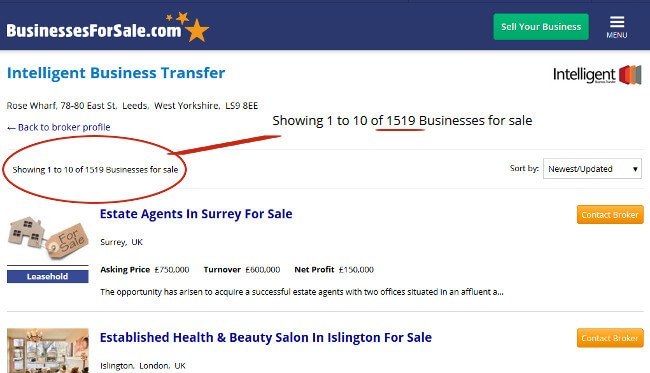
For example, to see how many clients Intelligent Business Transfer (a large broker in Leeds) has, one can head to businessesforsale.com. It's easy to find the relevant broker page and see how many businesses they've currently got listed. Below is a snapshot showing a massive 1,519 businesses on their books!
It's not just them
The same can be done for any other mass market broker. Kings had 120 listed (at time of writing). Blacks had 736. Turner Butler had 212 etc. By contrast, corporate finance firms and M&A advisories tend to have fewer than a dozen they're handling at any given time!
So, for most mass market brokers, we can get a good picture of how many clients they have on their books.
But how do we know how many they've sold?
That takes a bit more time and effort.
If a business has been sold, the ad is generally removed from the marketplace or it's prominently marked with a "Sold" sign.
There's another way to track the ones they've sold. Following the broker on social media will generate a flag every time they've made a sale. Yes, they do make a big song and dance about it when they've sold a business!
If they've got 1,000 business on their books and they are selling one a week, it's nothing to write home about as that's roughly just 5% of client businesses being sold in the average year. 95% are failing to sell.
So how do these business brokers and business transfer agents survive financially?
First, they generally charge a retainer at the point of signing the client up. This could range from a few hundred to £5K or more.
Even assuming an average of £1,000 per client, a thousand clients generates a million in fees! If they sell even 5% of those business, the success fees are a nice bonus. Given these mass market brokers tend to take on cheaper, lower end businesses, let's assume the average price at which they sell client businesses is only £200K. The average success fee is then £200K*(5% of 1000 clients)*6% success fee = an additional £600,000.
For many of them the "success fees" is a bonus. Most of their earnings come from the retainer. [[Added: See our analysis of the earnings for the K3 Group - Knightsbridge Business Sales and KBS Corporate, the UK's largest broker - they openly disclose that they make 60% of earnings from retainers!]]
So what can the business owner do to improve chances of sale? First, if the business is a micro or small business, under say a couple of million in turnover, our advice is to consider a DIY sale. If the very idea of DIY is terrifying, talk to us about free resources and other options available, including what we call the Assisted DIY route.
If the business is large enough for the better business brokers, corporate finance firms and M&A consultancies, there's another option We can assist to find the one best suited to your specific business, and at the right price. Many of them genuinely have success rates of 80% or more.
4. How to chose the right broker?
Solicitors are regulated by the Solicitors Regulation Authority. Accountants have to follow the ICAEW code of ethics. Every other professional or trade - from dentists to plumbers - has a trade body, industry body or regulator.
Business brokers have nobody! There is an organisation in the US called the International Business Brokers Association (IBBA) but there's nothing international about it. It's very much a US affair. In the UK, a couple of small business brokers got together and started a "Federation of Business Brokers" many years ago.
However, almost no brokers signed up to it so it never took off. Neither the FCA nor the Financial Intermediary & Broker Association regulate business brokers (despite the latter's name)!
So if one has a complaint about a business broker, there's no industry body to help. Yet there are thousands of complaints against brokers every year! More on this topic, and the disputes that regularly end up in court, at the CEBTA site.
Quite simply, it's very easy to make the wrong choice when signing up with a business broker.
The good news: After years of experience finding the right brokers for business owners, we put together a detailed article on how to find the right business broker for your business. For larger businesses, there's paid assistance, so send a message from our contact page!

5. How do I protect against brokers leaking confidentiality?
For most businesses it's vitally important that news of the intended sale is kept confidential. Significant value in the business can be lost if staff, customers or competitors know the owners are considering selling.
But maintaining confidentiality is easier said than done. When emailing a business broker to make enquiries, the company name is sometimes disclosed in the email address. When doing an online valuation of a business a business owner is entering figures that could be used to reverse engineer the identity of the business. Even visiting a business broker's site could reveal identity via the IP!
But is there any danger in revealing it to a business broker? Generally, no. But some brokers have been known to "follow up" on an enquiry by calling on the company phone number. This is often answered by staff!. There have even been cases where the irate broker, in an attempt to get past the "gatekeeper", said that he needed to be put through to the boss because he was calling about the sale of the business. Yikes!
Here are three articles on maintaining confidentiality in the early stages when talking with brokers.
6. Does the business need a sector specialist broker?
Some brokers specialise in selling businesses in a specific industry, trade or sector. In an article we explain why hiring a sector specialist can make a big difference to get the vendor a much better price. We estimate that using a sector expert can makes a difference of as much as 250% in price, on average.
But finding all the brokers specialising in a specific sector is not easy as there is no public database or directory with this information. The database we maintain is the only comprehensive source of this intelligence in the UK.
And it's amazing just how many sector specialists there are in the UK!
For example, in 2024 there were about two dozen brokers specialising in the sale of just accountancy practices! They include the likes of Bains Watts & Co, Draper Hinks, Goldsmiths Accountancy Advisory Services, Maximiti Ltd, Nicolson Accountancy LLP, Owens Professional (now merged with Practice Sales), Proctor Partnerships Ltd, Retiring Accountants, Vivian Sram Ltd and many others.
The mass market business brokers never specialise - they tend to take on anything and everything, whatever the size, whatever the sector! Going with them is not the best way to achieve top price.
More...
For most businesses it's vitally important that news of the intended sale is kept confidential. Significant value in the business can be lost if staff, customers or competitors know the owners are considering selling.
But maintaining confidentiality is easier said than done. When emailing a business broker to make enquiries, the company name is sometimes disclosed in the email address. When doing an online valuation of a business a business owner is entering figures that could be used to reverse engineer the identity of the business. Even visiting a business broker's site could reveal identity via the IP!
But is there any danger in revealing it to a business broker? Generally, no. But some brokers have been known to "follow up" on an enquiry by calling on the company phone number. This is often answered by staff!. There have even been cases where the irate broker, in an attempt to get past the "gatekeeper", said that he needed to be put through to the boss because he was calling about the sale of the business. Yikes!
Here are three articles on maintaining confidentiality in the early stages when talking with brokers.
Our comprehensive list of which brokers specialise in which sectors, out of the 1000+ business brokers in the UK, is unique. It has made a signficant difference for so many business owners taking their business to market.

7. How much do business brokers charge?
Some facts about business broker fees:
- Almost all brokers have a "success fee" - payable if they successfully sell the business;
- This fee is a percentage of the sale price: generally from 1.5% all the way to 12%;
- The larger the business, the smaller the percentage: <2% would apply to £10m+ firms;
- Corporate finance firms etc., selling the larger businesses, charge lower percentages;
- Businesses of under £1m in value tend to get charged 5% - 12%;
- Many brokers also charge a retainer at point of engagement;
- Retainers can be as low as £500 (for a micro business) or £50K (for a £10m firm);
- Some brokers are willing to spread the retainer payment over several months;
- A few brokers charge 'milestone' fees (at signed Heads of Terms, for example);
- Some brokers at the bottom end of the market operate on a no-sale-no-fee basis;
- With brokers selling smaller businesses, there's sometimes a 'penalty' payable if you take your business off the market.
There's more on business broker fees here and a free download of our whitepaper on how fees (and fee structures) work when selling a business.
Hiring a no-sale-no-fee broker is NOT a zero risk proposition. Some of these business brokers are the most dangerous and exploitative ones around and account for the large majority of cases that end up in court.
Getting Value For Money
For clients who want a competent and highly capable broker, there's no way around it, they are going to have to pay a retainer. Why? For two reasons.
First, these brokers are going to put in a lot of effort - hundreds of hours of effort. They add substantial value by analysing accounts and financial ratios, calculating EBITDA, valuing the enterprise etc. They also prepare various documentation - from business plans to financial projections to the CIM. That's just the start!
These firms would have nothing to show for their time and effort if the client pulls out. A retainer is part compensation for that time but also evidence, that the client is serious about selling and not just 'fishing around'.
There's another reason: Quite simply, they charge a retainer because they can. If they are good at what they do, they are in high demand. When we are matching clients with brokers, we are frequently amazed at how often brokers turn down even great clients. They do so because they are fully booked up!
How does one know whether the broker to whom they're paying a large retainer is any good at what they do? And whether it's worth risking that money?
The best way is to use our servicee and take advantage of our data and expertise. However, for business owners doing it themselves, there's no alternative to a lot of painstaking research. We advise on how to choose a broker. And below are good questions to ask a business broker.
8. What are good questions to ask a broker?
There are good questions specific to larger businesses on which we coach our clients. But a start for smaller clients could be these questions:
1. Who will be handling my account?
With lower end brokers it’s not uncommon for one person to sign the client up, get his commission, and hand the client to a bunch of poorly trained staff!
It's a good idea to ask for the name/s of the person/s who'll be handling the sale. It's useful to also know who'll be updating shareholders / directors of the client as the assignment progresses.
2. How much do you charge, what is your fee structure and what do those fees cover?
It's important to get a clear picture on this right at the start. When eventually signing the contract, it's worth making sure that the terms match exactly the vendor's understanding of their charges. See our free guide to business broker costs.
3. Is your key contact capable of advising on multiple exit options?
A trade sale may not be the best option but brokers who have no experience in, say, Management Buyouts, EOTs, MBIs etc would seek to guide the client to the exit that's within their capabilities even if that's not the best exit for the shareholders. It's worth taking names, titles, experience and qualifications of the people who’ll be involved in selling the business. It's also not a bad idea to check them out in LinkedIn and elsewhere.
4. Who will be conducting the valuation of my business and are they professional accountants?
Brokers argue that their vast experience with real life mergers and acquisitions puts them in a better position than accountants to value businesses.
Maybe, maybe not.
A broker has incentive to inflate the price in an attempt to gain the instruction, and many do just that. An unrealistically priced business will put buyers off. Starting off high and lowering the price later makes the seller look desperate.
5. Will you put the valuation in writing together with your reasoning behind the figure/s?
How often do they list a business at one price and then recommend to the seller six months later than the price needs to be reduced? And how often is that followed by another reduction when even that price doesn’t work?
6. What exactly can I expect from you at various stages of the process?
How much of work will they be doing, what work, and how will they keep the client updated? How often? Who'll be the person responsible for liaising with the client?
7. Where , how & for how long will you market my business? Can I see examples of teasers & CIMs you’ve written?
Will there be any extra costs for the marketing?
Are their CIMs well written, persuasive, professional? If you were a business buyer would the teaser tempt you in? Where will they be advertising the business ...and for how long.
8. Have you successfully sold businesses like mine? Any examples?
Ideally, they’d also be able to provide testimonials from named (not anonymous) business owners who’ve successfully sold through them. It's worth getting an idea of the typical size of the client businesses they sell and the sectors they specialise in.
Their understanding of and track record in selling your type of business is what you’re after.
Need assistance? Contact us to request a business-for-sale consultancy prior to starting your broker search.
9. How to negotiate price and terms with brokers?
Most brokers are open to a bit of negotiation on fees, corporate finance firms and M&A firms less do.
Here are some tips on how to get the best deal with brokers. Obviously, a third party, like us, who do these negotiations on a regular basis are better placed to get discounts (especially as we don't charge brokers a commission or 'introducer fee' which can often be 10% to 25% of what they charge the client). Being a potential source of future leads for the broker puts us in a much stronger position and we have often negotiated a whole percentage or two off the success, for our average client - a reduction of £50K+ in fees!
Unfortunately, the client is not in the best position to negotiate the deal. But this guide to broker fees and our free whitepaper on fees in the M&A industry (PDF) should help.
10. What to look out for in the broker contract?
Before acting for a client, the broker is going to want the client to sign a contract. The contract may be called by many names - engagement letter, instruction letter etc.
Whatever the terminology, it's a contract and it's a legally binding contract at that. Sometimes the "letter" terminology makes business owners complacent and they proceed without independent legal advice.
That's a serious mistake!
Some hard-sell brokers pressure business owners to sign earlier rather than later and even provide incentives to encourage an on-the-spot decision. However, even the genuine, reputable brokers are going to have contracts that are drawn up to protect their interests, not the client's. So it's a good idea to have the contract vetted by an independent lawyer.
1. 14 day cooling off period
There is none! Cooling off periods exist to protect consumers, not businesses.
This is a business to business contract. Even if a persons signs the contract in their own name, rather than as the business owner, they may not be able to rely on that in court to justify pulling out of the contract within the 14 day period.
Once the contract is signed, it's signed, and it's difficult to impossible to get out!
2. The Danger Of Off-Contract Clauses
Vendors need to read ALL parts of the contract: Is there a flip / reverse side to the document? It's more likely to host the terms that are not in the client's interests. There is, of course, also the very small print at the bottom.
Another common practice is off-paging: It's worth studying the contract carefully for references to off-page terms & conditions, T&Cs that reside on their website or elsewhere.
3. Per Hour Billing Can Be An Incentive To Take Longer
Hourly billing is common with some professionals. With a broker, however, it is not necessary and one could be opening oneself up to some pretty hefty charges that are difficult to justify but which one is contractually obliged to pay.
Many good brokers do take an upfront fee, and some are worth it, but all enquiries need to be made to get satisfaction that there's likely value for money in the instruction. A get-out, a way to terminate the contract if it's not working to one's satisfaction, is also a good clause to have.
4. Transfer Of Contract
It's worth strictly refusing to accept any condition that allows the transfer of the contract to another party. If the broker's business closes, the contract should end and not get transferred to an unknown third party. Regularly going bust is part of the “business model” for some brokers. They then 'sell' their 'book' to someone else or phoenix their original business.
5. Calculation Of Broker's Commission
High risk terms to agree to in clauses relating to calculation of commision:
- Accepting to pay, on sale, a percentage of the 'valuation' (rather than the achieved price).
- Agreeing to pay the broker's full success fee in cash on the exchange of contracts (if it's not a 100% cash transaction, the client may not have the liquidity to pay the fees on the day of the sale).
6. Good Faith
There is no legally accepted definition of Good Faith and a promise to act in good faith may be worthless. "Good faith" is subjective.
7. Power Of Attorney
A Power of Attorney gives the broker the power to accept or decline offers on the client's behalf. The client might want to ensure the contract says the brokers are acting only as 'agents'. They can enter negotiations on the client's behalf & agree to figures and terms … provided they make clear to the investor that it's provisional & subject to the client's final approval.
8. Penalty Clauses
If there’s a penalty for the client withdrawing from the sale, it's worth negotiating it to be a fixed penalty figure to compensate the broker for the time spent on the now aborted sale. Tying it to either the original (possible unrealistic) valuation or even to “offers” received from buyers is an unnecessary concession to make.
9. Notice Periods
A notice period is a notice period. If the client is required to give a 30 or 60 day notice period prior to withdrawing from the contract, are there conditions to such withdrawals? Some brokers stipulate that if the client cancels the contract while a potential buyer is showing interest, the client us still liable to pay commission. Given it’s not difficult to fake a “potential buyer” it pays to be cautious about conditions tied to the notice of termination of contract.
We have copies of hundreds of contract / engagement letters from brokers all over the UK and have seen the good, the bad and the ugly. Our clients get the right terms when they sign up with a broker.